Introduction
Bespoke is often misunderstood.
It is not simply about choice, or variation, or the ability to personalise. It is about precision — creating something that is shaped specifically to the relationship between the object and the person wearing it.
A watch, by its nature, is deeply personal. It sits on the body, moves with it, and over time becomes part of how it is experienced. The strap is the element that makes that relationship possible.
And yet, it is often the least considered.
What "Bespoke" Really Means
The term is used freely — alongside “made to order”, “custom”, and “standard sizing” — often interchangeably.
But true bespoke is something more exacting.
It means the piece is made from the ground up, for one individual watch and one individual wrist. Not adapted. Not selected. Designed and constructed specifically, with no reference to standard sizing or predefined templates.
It is this absence of compromise that defines it.
Why It Exists
There are many reasons a watch strap may not feel right.
It may be uncomfortable — too rigid, too loose, or poorly balanced.
It may not suit the watch — visually or proportionally.
Or it may simply fail to reflect how the watch is worn.
In many cases, these issues are subtle. But over time, they become impossible to ignore.
Bespoke exists to resolve this — not through excess choice, but through considered adjustment. Length, taper, thickness, material, and construction are all brought into alignment so that the watch sits naturally, without distraction.
The Process, Simplified
The process itself is deliberately simple.
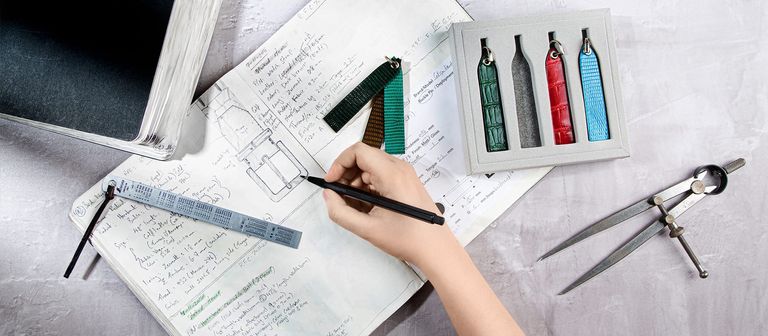
It begins with the watch and the wrist.
Measurements are taken not as isolated numbers, but in relation to how the watch sits and moves. Material and colour are considered in context — not in isolation — taking into account the character of the watch and how it is worn.
From there, the strap is made entirely in-house.
No outsourcing. No standardisation. Each element is cut, shaped, and finished by hand.
The final stage is fitting — where the strap is adjusted and refined on the wrist, ensuring that what was designed in theory translates precisely in practice.
On Fit
Fit is where bespoke becomes tangible.
Small variations — often fractions of a millimetre — determine whether a watch feels balanced or unsettled. Whether it sits comfortably, or constantly needs adjusting.
This is why measurement is not treated as a task for the client to complete, but as part of the craft itself.
The aim is not simply accuracy, but ease — allowing the wearer to experience the result, without needing to navigate the technicalities behind it.
Material and Colour
Material is not a question of variety, but of appropriateness.
Different watches demand different responses. A vintage piece may call for restraint. A contemporary case may allow for more contrast. Texture, tone, and finish all play a role in how the watch is perceived and how it integrates with the wearer.
The intention is not to offer unlimited choice, but to guide towards the right one.
Because when the material is correct, it does not draw attention to itself — it completes the watch.
Final Thought
The strap is often treated as an accessory.
In practice, it is the element that determines how a watch is worn, how it sits, and how it is experienced over time.
When considered properly, it does not compete with the watch — it resolves it.
Because the case and movement may define the watch, but the strap defines the relationship.
And that is where bespoke begins.
Closing
In practice, this is where the conversation begins.
Not about straps as objects, but about how a watch should feel on the wrist — how it sits, how it moves, and how it becomes part of the wearer over time.
This is the approach we take at INRO London. Each piece begins with the watch and the individual, and is shaped through quiet refinement until it feels considered, balanced, and complete.